
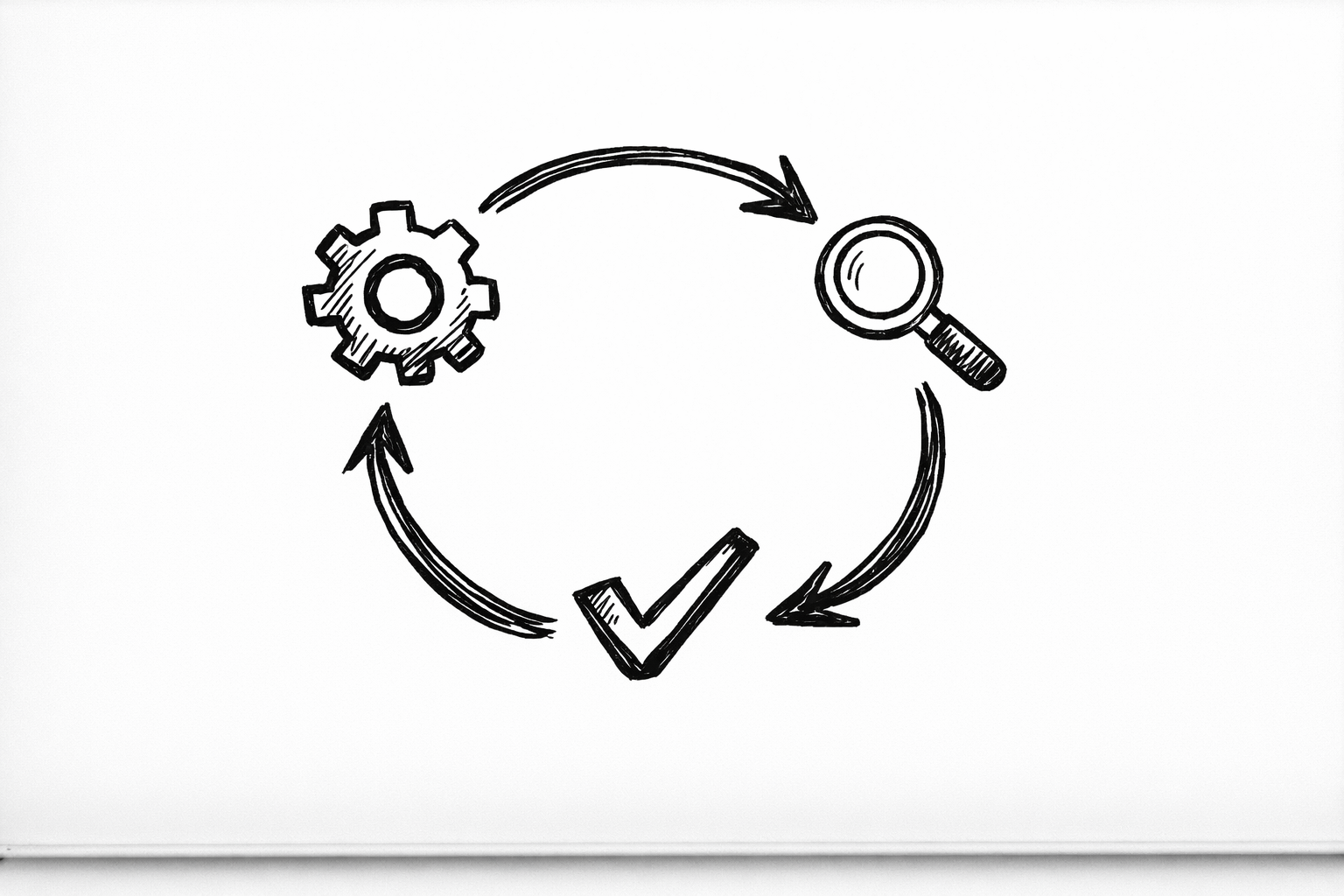
The Virtuous Cycle in AI Development
This week I had the honor of joining Louie Celiberti, Managing Director at Guggenheim Partners, and Michael "Mags" Maguire, our Director of Customer Success, on a panel at an HFTC Live! event exploring "Unlocking the Value of AI — It's a Matter of Scale." Mags, a master of guiding teams through top-down modernization transformation, offered invaluable insights on helping organizations navigate the cultural and operational shifts that AI demands. The conversation reinforced something Louie has championed for years: the concept of the "virtuous cycle" in AI.
For years, Louie Celiberti has championed the idea of the "virtuous cycle" in AI — a continuous loop where data, automation, and evaluation feed into each other to produce ever-better outcomes. He often contrasts this with the "vicious cycle," where poor governance, rushed implementations, and lack of human oversight lead to compounding mistakes that erode trust and value.
The distinction matters more than ever for executives deciding how to integrate AI into their organizations. The virtuous cycle isn't about getting it perfect the first time — it's about delivering incremental value, learning from each iteration, and building organizational confidence. As Louie emphasizes, the goal isn't speed for its own sake, but speed enabled by proper governance and practical, measurable improvements.
This is the essence of what Mags explored in "The Compound Effect of AI: Why Small Daily Improvements Beat Moonshot Projects" — small, consistent improvements compound over time into exponential transformation. His framework for incremental AI adoption directly supports the virtuous cycle approach: start where you are, generate feedback loops, and create organizational believers through tangible weekly improvements.
Defining the Virtuous Cycle
At its core, the virtuous cycle in AI means:
Self-Evaluation
Building processes where AI not only performs tasks but also evaluates its own outputs.
Continuous Refinement
Using those evaluations to refine the process in real-time.
Human-in-the-Loop
Measuring progress, iterating quickly, and keeping humans in the loop.
Built-in Governance
Ensuring governance, transparency, and compliance at every step.
When done right, the cycle accelerates over time — each iteration is faster, smarter, and more accurate.
Case Study #1: Data Review & Cleanup
One of my daily use cases is data cleanup. Imagine an analyst with a spreadsheet containing hundreds of tickers, each with columns for values sourced from the internet, SEC's EDGAR database, and elsewhere.
We built a team of AI agents, orchestrated to work together:
- The Excel agent opens the spreadsheet and sends tickers and values to the orchestrator.
- The orchestrator asks an EDGAR agent if the values have changed.
- If EDGAR can't find the data, a Web Researcher agent hunts for the latest values.
- Updated values are sent back to Excel, along with a source and a justification ("Updated due to recent 10-K filing").
It's not instant — 30–90 seconds per ticker — so we run it after hours. The analyst gets a summary email when it's complete. The result? Cleaner data, faster turnaround, and freed capacity for higher-value work.
💡 Key Virtuous Cycle Elements:
- Automation: Agents work autonomously after hours
- Evaluation: Multiple data sources cross-checked
- Documentation: Source and justification for every change
- Human Supervision: Analyst reviews summary, not every ticker
Case Study #2: Outlook Contacts Search Improvement
Another example: improving our Outlook Contacts Connector Agent. The latest upgrades made it faster, but I was frustrated by its search limitations. It could find any contact containing "saberin" in any field, but failed to find contacts where the email address ended with "saberin.com."
I asked Audition AI to perform the search — zero results. I then passed the chat thread to our "Chat Thread Investigator" agent, explaining my expectation of at least 50 results. The agent dug into the logs and tool calls, discovering that Microsoft's Graph API only supports "equals" searches for certain fields, not "ends with."
The AI and I discussed a workaround: perform a fuzzy search, then locally filter results to match the desired email suffix. Within hours, we had a dramatically improved search capability.
🔄 Virtuous Cycle in Action:
- Problem Discovery: AI couldn't find expected results
- Self-Investigation: "Chat Thread Investigator" agent analyzed logs
- Root Cause: Microsoft Graph API limitation identified
- Collaborative Solution: Human and AI designed workaround together
- Rapid Implementation: Fixed within hours, not days
Governance: Guardrails Against the Vicious Cycle
Without governance, transparency, and human oversight, AI initiatives risk falling into the vicious cycle — where errors compound, speed amplifies mistakes, and trust erodes.
⚠️ The Vicious Cycle Warning
Without proper guardrails, speed becomes dangerous:
- Errors compound instead of being caught
- Speed amplifies mistakes across the organization
- Trust erodes with each failure
- Teams abandon AI adoption entirely
The virtuous cycle demands discipline but rewards it exponentially. As we outlined in "The AI Operating System: Why Tools Fail Without a Way of Working", governance isn't a constraint — it's the enabler that allows teams to move faster with confidence. Louie's message is clear: proper governance, transparent processes, and human oversight don't slow you down; they're what make sustained speed possible.
📋 Document Processes
Create immutable audit trails of decisions and actions
📊 Measure Outcomes
Track real metrics, not vanity numbers
🔍 Reflect on Improvements
Build feedback loops that inform next steps
⚡ Test, Iterate, Repeat
Each cycle should be faster than the last
Audition AI: Proof That GRC-First Works
Audition AI was built as the first and most powerful GRC-first platform, enabling containerized, secure, compliant enterprise AI. With immutable audit trails and orchestration capabilities, it lets teams focus on outcomes, not plumbing.
It doesn't have to be Audition AI — you can build your own. What matters is embracing the technology and introducing your own virtuous cycle.
Closing Challenge
Building Your Virtuous Cycle
To executives: What does your virtuous cycle look like? Where can you start small, measure clearly, and build confidence?
To leaders like Louie: Keep preaching this message. The industry needs more voices emphasizing practical value over hype.
The organizations that win won't just adopt AI — they'll master the loop of building, measuring real value, learning from both successes and failures, refining their approach, and governing it properly from day one.
🎯 Start Your Virtuous Cycle Today:
- Pick one process your team does repeatedly
- Automate the smallest step that provides value
- Measure and document what works and what doesn't
- Iterate daily, not quarterly
- Scale through governance, not through bypassing it
As explored in "From Features to Agents: Building a Maturity Model for AI", the path from initial AI enablement to trusted partner status requires measuring not just functionality, but reliability, business value, and strategic readiness at every step.
The virtuous cycle is your path to speed, resilience, and sustained advantage.
Like this content?
Subscribe to our weekly brief for more insights on AI strategy and implementation
Subscribe to Weekly BriefReady to Build Your Virtuous Cycle?
Discover how Audition AI can help your organization implement governance-first AI with speed and confidence.