
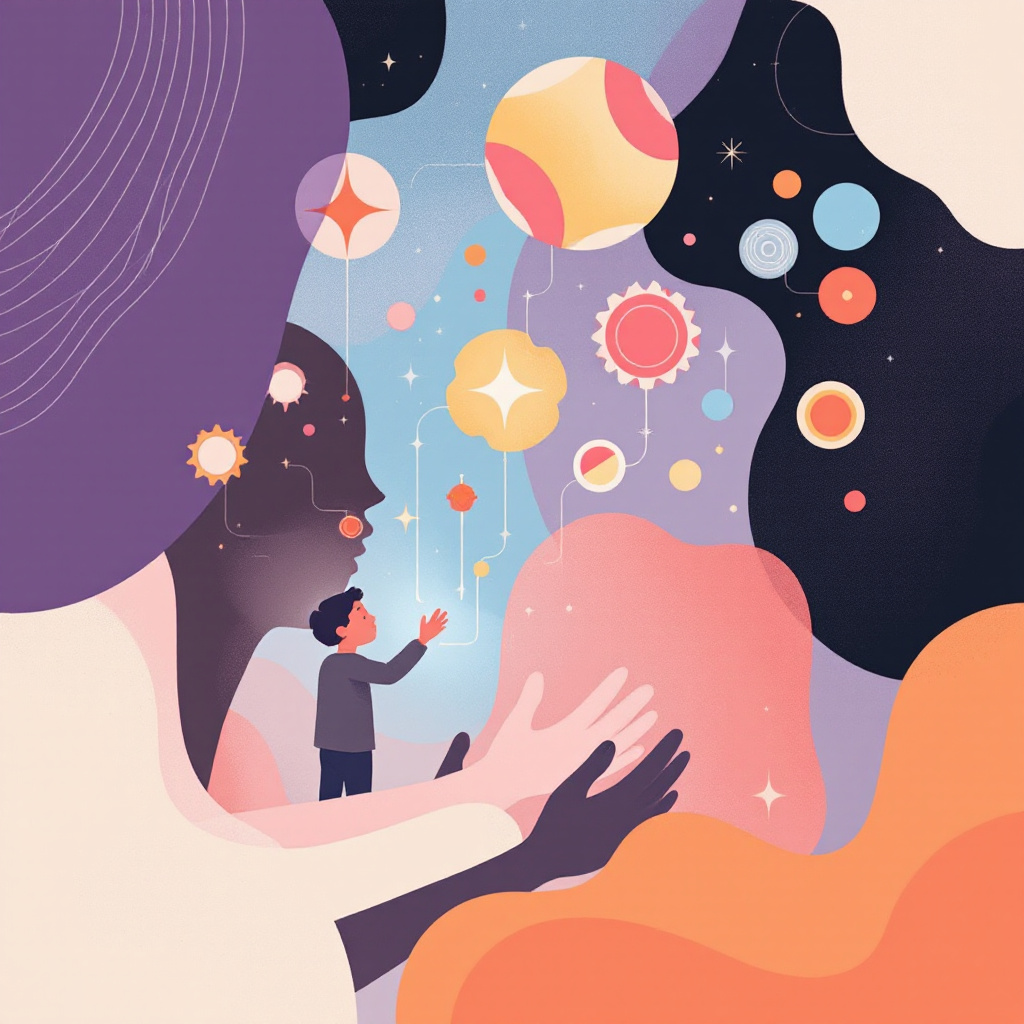
Innovation & Education
Kids Who Code
A new wave of young builders is using AI to turn ideas into apps — no syntax required. Welcome to the age of vibe coding, where the only barrier left is imagination.
Fay is eight years old. She lives in a world of water park simulators and Harry Potter chatbots — not the kind she reads about, but the kind she builds herself. Using an AI-powered coding tool called Cursor, Fay has created a growing catalog of personalized games without writing a single line of code. She describes what she wants. The machine builds it. Then she plays.
A few years ago, this would have sounded like science fiction. Learning to code meant learning to speak a computer's language — variables, loops, syntax errors, and the particular despair of a missing semicolon. Children who fell in love with technology had to apprentice in frustration before they could create anything that felt like theirs. But a seismic shift is underway.
Teaching kids to code is nothing new — and neither is finding ways to make it feel like play. I've been recommending leekwars.com to young people for years. It's a browser-based coding game where you program your leek — yes, the vegetable — to fight other leeks in an arena using real JavaScript. There's no hand-holding, no tutorial tracks: just a problem, a code editor, and the instant honest feedback of watching your leek either dominate or immediately perish. It's one of the best "is coding for me?" filters I know of. I still think it holds up. What vibe coding does differently is remove even that friction. As Sharon Saberin has noted, friction compounds — and when it vanishes, entire categories of work become possible.
Increase in searches for "vibe coding" in spring 2025, within weeks of the term being coined by Andrej Karpathy. Collins English Dictionary named it Word of the Year.
What Is Vibe Coding?
The term was coined in February 2025 by Andrej Karpathy, co-founder of OpenAI and former AI director at Tesla, in a post that quickly racked up 4.5 million views. Karpathy described a new approach to building software: describe what you want in plain language, let an AI generate the code, and iterate from there — no memorizing syntax, no debugging marathons. Collins English Dictionary named it their Word of the Year 2025. Merriam-Webster listed it as a trending term by March of that year.
The idea is elegantly simple. Instead of writing a function in Python or JavaScript, you type — or speak — something like: "Make a game where a penguin slides down a hill and collects fish." The AI interprets your intention and generates working code. You test it, tweak your description, and try again. The computer does the typing. You do the imagining.
"For a total beginner who's just getting a feel for how coding works, it can be incredibly satisfying to build something that works in the space of an hour."
— Harry Law, AI Researcher, University of Cambridge, via Girls Who CodeReal Kids, Real Creations
Who Is Fay?
Age 8. No coding background. Using Cursor, she built a water park simulator, a Harry Potter chatbot, and more — each created by describing what she wanted in plain English. Her story was featured by Girls Who Code as an example of vibe coding's potential for young learners.
Fay's story isn't an outlier. It's the opening act of a much larger story. Across classrooms, kitchen tables, and after-school programs, children are discovering that the distance between an idea and a working piece of software has collapsed to almost nothing.
In early 2025, Arlyn Gajilan — a digital news director at Reuters — watched her 11-year-old son Tobey come home discouraged, struggling with the challenges of dyslexia. Inspired by what she'd been reading about AI and vibe coding tools, she sat down at the kitchen table over spring break and, with no engineering background, built an AI-powered tutoring platform tailored specifically to how Tobey learns. The platform, reported in Scientific American, has since drawn the attention of educators who see it as a model for personalizing learning at scale.
The story resonates precisely because the technology didn't require expertise — it required empathy, curiosity, and the courage to describe a problem clearly. Those are skills children have in abundance.
Tobey's Tutor
At age 11, Tobey struggled with dyslexia and felt left behind. His mother used vibe coding to build him a personalized AI tutor — from scratch, with no engineering background. The platform attracted attention from educators nationwide as a model for learning-difference support, per Scientific American.
The Democratization of Building
Historically, coding was a craft with a steep apprenticeship. Platforms like Scratch, launched by MIT in 2007, made enormous strides in making programming visual and playful for children aged 8–12. Code.org's "Hour of Code" brought basic programming concepts into millions of classrooms globally. These were genuine revolutions. But even with blocks and drag-and-drop interfaces, the gap between "I tried coding" and "I built something I'm proud of" remained wide for many kids.
Vibe coding closes that gap in a new way. CodaKid describes it as flipping the traditional learning experience: "With the help of AI, kids can describe their ideas in natural language, and the platform translates those ideas into functional code." The instant feedback — see your idea come to life in seconds, adjust, iterate, try something wilder — is a fundamentally different relationship with technology than staring at a syntax error.
Platforms designed for young learners are multiplying rapidly. Tools like Replit, Lovable, and Cursor give aspiring builders AI-assisted environments where natural language does the heavy lifting. Imagi Labs partnered with Lovable to bring a "Vibe Coding Classroom Challenge" to grades 6–12. The Hour of AI — an evolution of the globally loved Hour of Code — now invites students of all ages into structured, age-appropriate introductions to building with AI.
"Vibe coding makes programming approachable, helping kids build skills for the future while having fun." — CodaKid, 2026
The Builders of Tomorrow Are Already Here
Of professional developers now regularly use AI tools, per a 2025 JetBrains study — underscoring that AI-assisted coding isn't a kids' experiment. It's the industry standard.
Alexandr Wang, who became the world's youngest self-made billionaire at 24 and now leads AI efforts at Meta, offered a striking prediction in a 2025 interview: "If you are 13 years old, you should spend all of your time vibe coding. That's how you should live your life." His reasoning: the intuition built by experimenting with AI tools now is the competitive edge of the next decade. The next Bill Gates, he suggested, might be a middle schooler who is vibe coding right now. This moment represents a genuine inflection point in the AI timeline — as documented in our December 2025 review of AI's journey from Turing to autonomous agents, the launch of accessible AI tools marks the moment when building with AI shifted from specialized engineer work to a capability for everyone.
That's not hyperbole. A 2025 JetBrains study found that 85% of professional developers regularly use AI tools, and 62% rely on at least one AI coding assistant. Google CEO Sundar Pichai reported that AI generates more than 30% of new code at Google. Replit CEO Amjad Masad noted that 75% of their users never write a line of code themselves. The question of whether a child "can code" is becoming less about mastering syntax and more about mastering intent.
Andrew Chen, a prominent venture capitalist, framed the cultural trajectory in a 2025 post: most code will increasingly be written by the time-rich — and that means students and kids, not just software engineers. The same democratizing arc that turned everyone into a photographer and a filmmaker is now turning everyone into a developer.
Curiosity First, Syntax Later
None of this means traditional programming knowledge is obsolete. The best young vibe coders still benefit enormously from understanding the underlying logic of what they're asking AI to build. Knowing what an API is, understanding what a loop does, being able to read an error message — these skills make the difference between a builder who gets stuck and one who keeps going. The tools lower the floor, but the ceiling is still lifted by those who choose to learn more deeply.
The Raspberry Pi Foundation's Code Club now offers AI and machine learning projects for young people in non-formal settings. Students train models to recognize images and sounds, explore facial recognition, and build interactive projects — designed to be engaging in short sessions that leave room for creativity. The goal isn't to replace curiosity with instruction; it's to give curiosity somewhere to run.
What vibe coding offers, ultimately, is a different first experience of building something. Not the frustration of a compiler refusing to run because of a misplaced bracket. Not the slow accumulation of vocabulary before you can say anything interesting. Instead: an idea, a conversation with a machine, and a working thing that didn't exist an hour ago. For a child, that's not just useful — it's transformative.
Tools Young Builders Use
What Comes Next
We are in the earliest days of this shift. The tools will improve. The platforms designed for young learners will multiply. The projects kids build today — a water park simulator, a Harry Potter chatbot, an AI tutor stitched together from love and spring break afternoons — are prototypes not just of software, but of a generation's relationship to technology.
That generation won't remember when coding was a specialized skill earned through years of study. They'll remember the afternoon they described an idea to a machine and watched it come alive. They'll remember the feeling — curious, capable, creative — of being someone who builds things. And from that feeling, extraordinary things will grow.
The future doesn't wait for the syntax to be perfect. Neither, it turns out, do kids.
"The barrier to building software has never been lower."
— bachynski.blog, Vibe Coding Guide 2026References
- Béchard, D. E. "How one mom used vibe coding to build an AI tutor for her dyslexic son." Scientific American, January 16, 2026. scientificamerican.com
- "Vibe Coding for Kids: The Ultimate Guide (2026)." CodaKid, February 11, 2026. codakid.com
- "Vibe Coding for Students." Girls Who Code, May 15, 2025. girlswhocode.com
- "The next Bill Gates will be a 13-year-old who is 'vibe coding' right now." Fortune, September 19, 2025. fortune.com
- "Vibe coding." Wikipedia, Updated March 2026. wikipedia.org
- "Vibe Coding: Build Your First Game Using AI." Imagi / Hour of AI. imagilabs.com
- "Artificial Intelligence Projects for Kids." Raspberry Pi Foundation / Code Club, October 2024. raspberrypi.org
- LeekWars — Browser-based coding arena where players program their leek in JavaScript to battle other leeks. A creative, low-barrier introduction to real programming logic. . leekwars.com
- Saberin, B. "AI In Review: A Visual Timeline of AI's Journey (2021–2025)." Audition AI Blog, December 24, 2025. audition-ai.com
- Saberin, S. "Why Smart Teams Still Move Too Slowly." Audition AI Blog, February 18, 2026. audition-ai.com
Like this content?
Subscribe to our weekly brief on AI innovation and the future of work
Subscribe to Weekly BriefIs Your Firm Ready to Build With AI?
Audition AI helps enterprise teams move from experimenting to executing — with governance built in from day one.