
Two years ago, everyone assumed AI would look like a better Google Search. You type. Someone else's computers think. Someone else's servers hold your data. Someone else's company decides what you're allowed to ask.
That assumption is quietly dying.
While everyone watches OpenAI, Anthropic and Google fight over who has the smartest chatbot, something far more interesting has been happening underneath. The models are escaping. Not metaphorically. Literally.
Today, companies can download frontier-class language models, run them inside their own datacenters, fine tune them with proprietary knowledge, and never send a single byte to anyone else.
That changes everything. Especially on Wall Street.
Eating My Own Dog Food
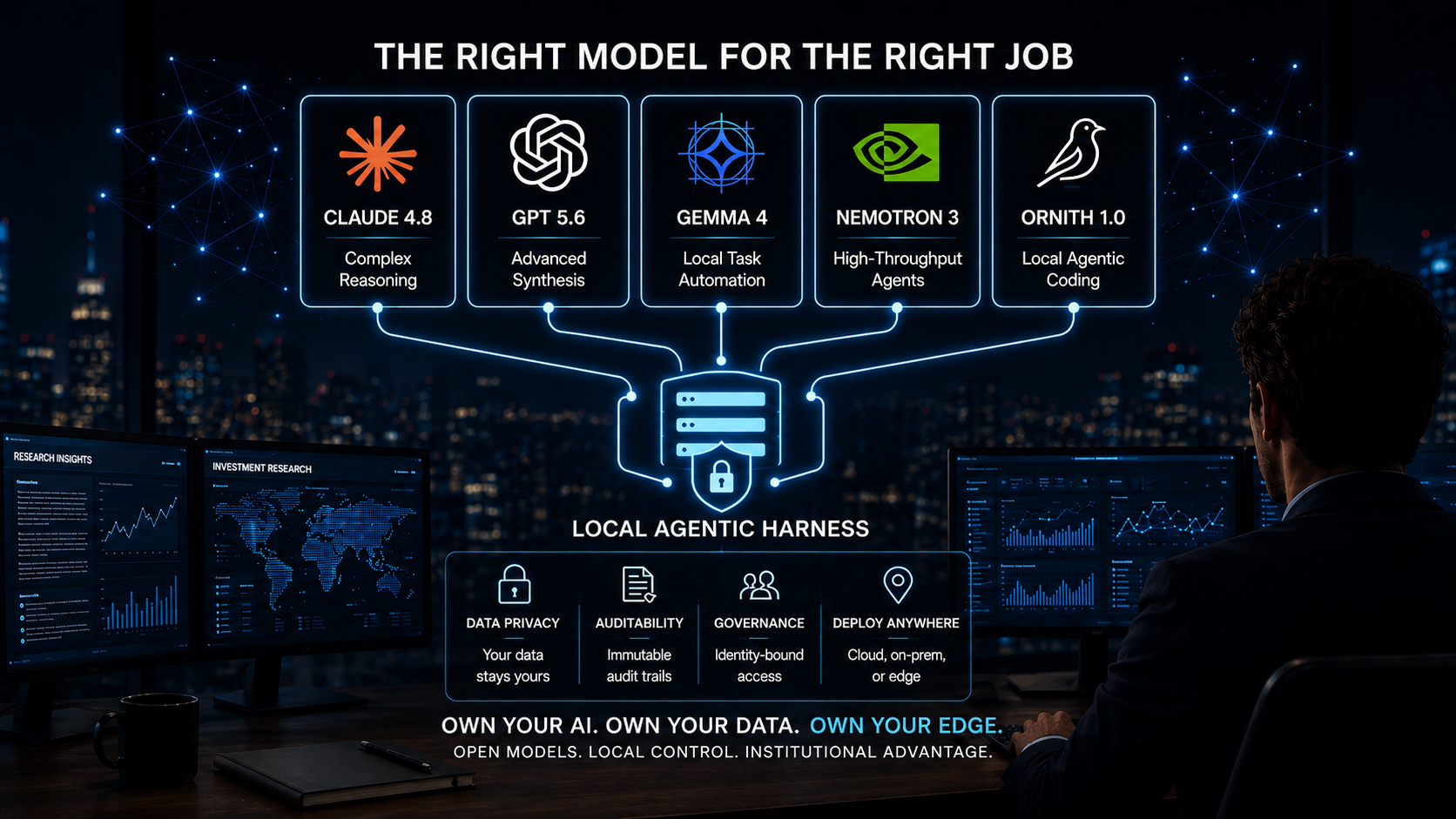
Before we begin, it's worth noting that this article is itself an example of the ideas it explores. The research was performed collaboratively using Claude, ChatGPT, and Grok to compare viewpoints and validate claims. The article was then written inside Audition AI using a personalized writing agent that has learned my style over time. Finally, the HTML, CSS, and publishing workflow were completed by a local agentic harness running entirely on an aging NVIDIA GeForce GTX 1080 Ti using Ornith-1.0-9B, an American open-weight language model. Not every task required a frontier model—and that's precisely the point.
Modern AI isn't about finding one model to do everything. It's about orchestrating the right models for the right jobs, wherever they deliver the greatest value.
Everyone Is Asking the Wrong Question
Whenever a new model comes out, the Internet asks one question: "Is it better than the latest GPT? Is it better than Claude?"
Wrong question.
Suppose I told you there was a car that was 95% as fast as a Ferrari. It costs 1/50th as much. You can modify it. You own it forever. Nobody can repossess it. Nobody charges you every mile you drive. Nobody tells you where you're allowed to go.
Would you keep asking whether it's faster than the Ferrari?
Of course not.
Ownership changes the economics. The exact same thing is now happening with AI.
Closed Models Are Amazing
Claude Opus. GPT-5.5. Gemini. They're incredible. If your goal is solving the hardest reasoning problems on Earth, they're still the kings.
But that's only one axis. The enterprise world cares about a completely different set of questions:
Suddenly, "95% as smart" starts beating "100% as smart."
Benchmarks hide reality. Once the reasoning gap becomes small enough, economics takes over.
The Americans Quietly Built an Open-Weight Ecosystem
While Chinese labs have recently dominated the raw open-model leaderboard, several American organizations have produced remarkably capable open-weight models with different priorities.
Google's Gemma 4 focuses on efficiency, multimodal reasoning, and permissive licensing.
NVIDIA's Nemotron 3 was built for agentic systems, throughput, and enterprise deployment.
IBM's Granite emphasizes predictable enterprise behavior.
Microsoft's Phi continues pushing incredibly efficient models.
Arcee AI's Trinity has become one of the most interesting entrants for long-horizon agent workflows.
None consistently beat Claude Opus or GPT-5.5 across every benchmark. That's not the point. They're getting close enough that entirely different advantages begin to dominate.
Why Hedge Funds Are the Perfect Example
Hedge funds have something most AI companies don't: proprietary information.
Research. Models. Meeting notes. Investment theses. Channel checks. Alternative datasets. Analyst discussions.
That information is literally the firm's competitive advantage. Sending it to any external API—even a trusted provider—is a conversation many CIOs would rather avoid.
Now imagine the alternative: everything stays inside. Forever.
Imagine Your Firm's Collective Memory Becoming Searchable
Every investment memo. Every earnings call. Every management meeting. Every analyst debate. Every failed thesis. Every successful thesis. Twenty years of institutional knowledge.
Instead of searching folders, an analyst simply asks:
"Show me every semiconductor thesis where we became more bullish after management increased capital expenditures."
The answer appears in seconds. Nobody has to remember which analyst wrote it in 2019. Nobody has to remember where it was stored.
The firm remembers.
Earnings Season Becomes a Different Experience
Today, analysts spend days reading transcripts.
Tomorrow, an AI agent reads every transcript overnight. It notices:
- changes in language
- guidance shifts
- executive confidence
- competitor mentions
- pricing pressure
- supply chain commentary
- deviations from previous quarters
Then it compares all of that against your own historical research. Instead of reading 200 transcripts, analysts investigate the 12 that actually changed something important.
Your Quant Team Gets a New Teammate
Not a replacement. A teammate.
Imagine every quantitative researcher having an assistant that understands:
- your internal libraries
- your signal definitions
- your backtesting framework
- your coding standards
- your documentation style
...without any of that code ever leaving your infrastructure.
That assistant never sleeps. Never forgets. Never loses context.
This Is Where Economics Wins
People keep asking: "Can an open model beat GPT-5.5?"
I think that's yesterday's question.
The better question is: Can an open model create more enterprise value?
Increasingly, yes.
Because once the reasoning gap becomes small enough, economics takes over.
Privacy wins.
Customization wins.
Ownership wins.
Control wins.
This Isn't About Replacing Frontier AI
I don't think hedge funds should abandon Claude. Or GPT. Or Gemini. Quite the opposite.
Use them where they provide unique value:
- complex investment reasoning
- difficult coding
- deep synthesis
- exploratory research
But let open models handle the other 90%:
- document ingestion
- transcript analysis
- RAG
- internal search
- note summarization
- entity extraction
- daily research automation
- knowledge management
That's where the economics become compelling.
The Real Shift
The biggest change in AI isn't that models are getting smarter.
It's that organizations are beginning to own them.
For decades, software was something you bought. AI is becoming something you hire.
And just like employees, the most valuable ones often aren't the geniuses. They're the ones who understand your business, protect your secrets, remember everything you've ever learned, and show up every single day.
That's what open-weight models are becoming. Not cheaper ChatGPTs. A permanent part of the enterprise.
And I think Wall Street is only beginning to realize what that means.
The biggest opportunity isn't finding the smartest model. It's building infrastructure that lets your organization deploy any model, anywhere it creates the most value.
Stay Current
Like this content?
Subscribe to our weekly brief for more insights on AI strategy, governance, and enterprise execution.
Subscribe to Weekly Brief →Next Step
Ready to deploy AI on your terms?
Discover how Audition AI helps enterprises orchestrate local and frontier models with complete governance and control.
Tags